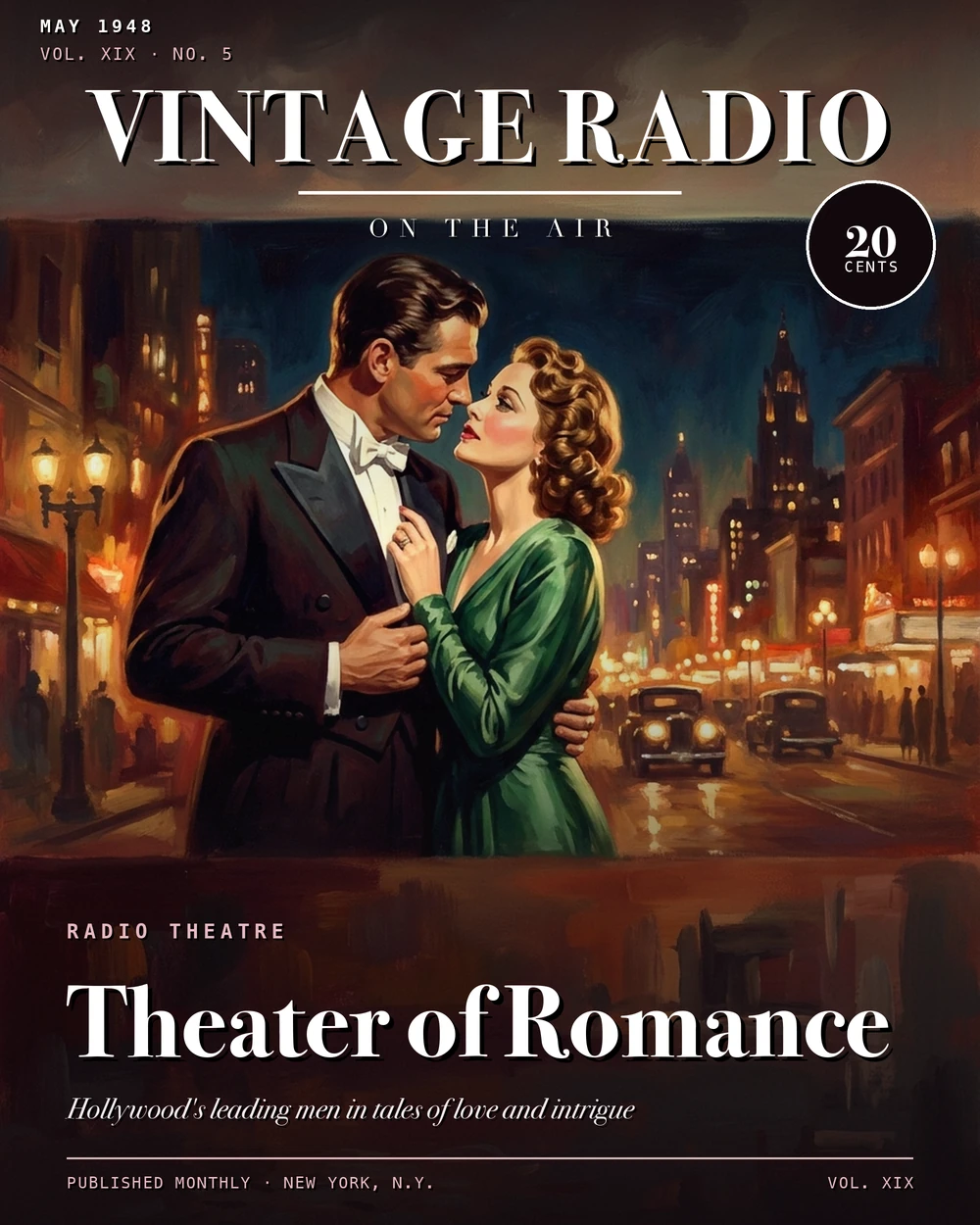
Theater of Romance
How It Got on the Air
Theater of Romance began quietly — an unsponsored series called simply Romance, with its first known broadcast on August 23, 1943. In that early phase, the show ran as a CBS sustaining program, filling schedule gaps and occasionally substituting for larger productions like Lux Radio Theater and Life with Luigi. Host-announcer Frank Gallop gave these early broadcasts what one contemporary description called "an almost teary presence," setting a sentimental, slightly formal tone that would carry through the show's life. The opening signature line — "My name is Romance..." — anchored every episode with a sense of deliberate occasion, even when the rest of the radio schedule treated the slot as interchangeable.
The show's real identity took shape on July 4, 1944, when it relaunched as Theatre of Romance under a Colgate Company sponsorship package that included Colgate Tooth Powder, Palmolive Soap, and Halo Shampoo. The rebrand brought new ambitions: Hollywood-caliber talent, radio adaptations of famous films and stage plays, and a move out of New York to Los Angeles in the summer of 1945, where the show thereafter performed before a live audience. Arnold Moss served as the first host of the relaunched version; Frank Graham later took over the hosting duties and stayed with the program through much of its subsequent run.
The Hollywood Years
The Colgate-sponsored phase, which ran from July 4, 1944 through August 27, 1946, was when Theater of Romance made its strongest case for being something more than a schedule-filler. The show functioned as a half-hour counterpart to the hour-long Lux Radio Theater — both programs presenting Hollywood names in classic film adaptations, both underwritten by personal-care companies competing for the same audience. Where Lux was the prestige hour, Theater of Romance was the more intimate version, thirty minutes of sentimental drama with recognizable faces doing the work.
And the faces were recognizable. During this two-year run, the show drew Humphrey Bogart, Henry Fonda, Errol Flynn, Douglas Fairbanks Jr., Shirley Temple, Van Johnson, Gregory Peck, Orson Welles, and James Stewart, among others. The radio adaptations were written by Jean Holloway, who shaped classic films and stage plays into the half-hour format. The material she worked from was substantial: Casablanca, Dark Victory, It Happened One Night, Goodbye Mr. Chips, Stage Door, and Daddy Long Legs all made it to the Theater of Romance microphone. A July 18, 1944 broadcast of Stage Door — based on the George S. Kaufman and Edna Ferber play — was directed by Marx Loeb with music composed and conducted by Ben Ludlow, giving a sense of the production values the show maintained during its sponsored peak.
The sentimental music backdrop that characterized the show wasn't just filler between scenes. It contributed to the show's reputation for being more polished and elegant than the typical radio drama of the period, giving even familiar story material a certain texture that the sparse, effects-heavy crime dramas of the same era didn't attempt.
After the Sponsors Left
When the Colgate sponsorship ended in August 1946, Theater of Romance shed most of its Hollywood gloss and settled back into a sustaining role on CBS. The show continued, but its character shifted. Rather than name stars doing showcase turns, the program began to rely on radio's own working professionals — actors who lived inside the medium rather than visiting it.
That transition eventually brought in a creative team whose work would outlast the show itself. During the later unsponsored years, director-producer Norman Macdonnell took over from director Albert Ward, and writer John Meston joined as writer-editor. The stock company that formed around them included William Conrad, Georgia Ellis, John Dehner, and Lawrence Dobkin — character actors who knew how to carry a drama without the borrowed weight of a film star's reputation. Other top radio performers of the era passed through as well, among them Bob Bailey, Richard Crenna, Elliott Lewis, Lurene Tuttle, Gerald Mohr, and Barbara Jean Wong.
An episode broadcast on August 6, 1951 — titled "Pagosa" — has since been recognized as a step toward something larger. It is credited as a formative piece in the development of Macdonnell and Meston's western drama Gunsmoke, which would go on to become one of radio's most enduring programs. Whatever Theater of Romance lacked in star power during these years, it was apparently serving as a workshop for ideas that mattered.
The Long, Restless Run
Across its twelve years on CBS, Theater of Romance was rarely stable in one place for long. Researcher Ray Stanich's broadcast log documents at least twenty changes of time slot or broadcast day across the run — a figure that reflects just how thoroughly the program functioned as a floating piece of the network schedule rather than a fixed appointment. It substituted for Gunsmoke, Life with Luigi, and Lux Radio Theater at various points, filling gaps without ever quite becoming indispensable to any single time period.
There was one more attempt at sponsorship. In the fall of 1952, Jergens Lotion briefly came on board, and the show was rebranded as The Hollywood Playhouse of Romance. That arrangement didn't hold, and the program reverted to its sustaining identity and its simpler Romance title before the run ended. The episode catalog — 207 installments spread across more than a decade — reflects the full range of those identities, from Hollywood film adaptations under Colgate's banner to original dramatic pieces built around the radio stock company, with titles like "Warrior's Return," "Moment on a Train," "Roman Afternoon," and "The Story of Mayerling" suggesting the tonal range the show attempted in its later, quieter years.
The final known broadcast aired on January 5, 1957, ending a run that had started as a spare sustaining drama and passed through at least three distinct identities along the way. Theater of Romance never had the cultural footprint of Lux Radio Theater, but it occupied its corner of the CBS schedule for fourteen years, adapted a significant body of classic material, and gave a generation of radio craftsmen — including the people who made Gunsmoke — a place to develop their work.